

For those who used to or still often travel, the concept of a travelling board game might be familiar to you. Specially adapted to make the pieces less exposed to turbulence, smaller, but the fun is still there, even if it is a little finicky. In 2001, with the Game Boy Advance offering family-friendly portability, what better way to beat the tedium of motion than through a board game you don’t have to clean up, in Tweety and the Magic Gems.
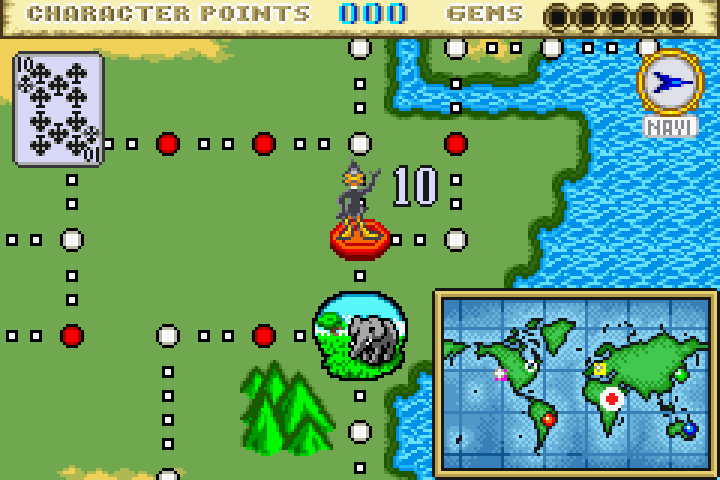
Poor Tweety has been cursed to be encased in concrete, unless the seven magic gems are recovered from the four corners of the Earth. So it is up to Bugs Bunny, Daffy Duck, Porky Pig, Sylvester the Cat, Yosemite Sam, and Marc Antony. Seeking glory for themselves, to traverse the earth and collect the gems before anyone else does. Along the way, items and mini-games will either aid or halt your progress. So it will take some luck and some forward-thinking to be the one that saves the day.
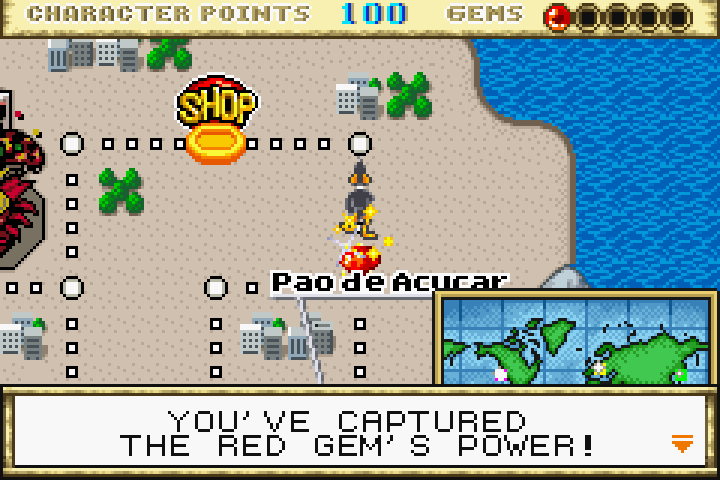
On its surface, Magic Gems appears to be a party game, similar to Mario Party, where you and your friends try to seek out stars (in this case, Gems). You move through the use of cards, which is a fun mechanic even if it’s not that much different from a die, but allows opportunities to grab bonuses like drawing a lucky seven, and getting bonus items. Whereas Mario Party invents fictional boards from all over the Mushroom Kingdom, Magic Gems settles for a global adventure across the world map, giving the game some bonus edutainment points. The Looney Tunes licence might seem odd at first, but it manages to make sense the further along you get. The sprite work looks pretty enough to convey the characters. As is typical for the Game Boy Advance, the soundtrack is catchy and may stick with you throughout.

Present on the cart are a plethora of mini-games that can be accessed from the menu or by hitting the red spaces in standard play. These, too, follow the standard party game format and make use of the limited control scheme rather well. The victor in these games awards the player in-game currency to buy items to aid or halt other players’ progress. These can come down to luck and skill, so even if you are behind in the main game, you can quickly rebound by playing well. While this is yet another staple of the Mario Party franchise, the mini-games do make sense in a Looney Tunes context.

Magic Gems is a fun enough digital board game that I have returned to throughout the years. Its take on the classic formula and use of licence make it an intriguing proposition, for a game on the go, this feeling is multiplied. While Mario Party has multiple portable entries, the competition is always welcome. At least, you do not have to go halfway across the world and back again to enjoy this globe-spanning adventure.
If you want more positive reviews delivered to the e-mail box of your choice, you can click on that little text bubble at the bottom of the screen. Do you agree or disagree? or have a suggestion for another pop-culture artefact that needs a positive light shone on it? Leave a comment in the comment box below! But remember to keep it positive!
 The Real Mr. Positive